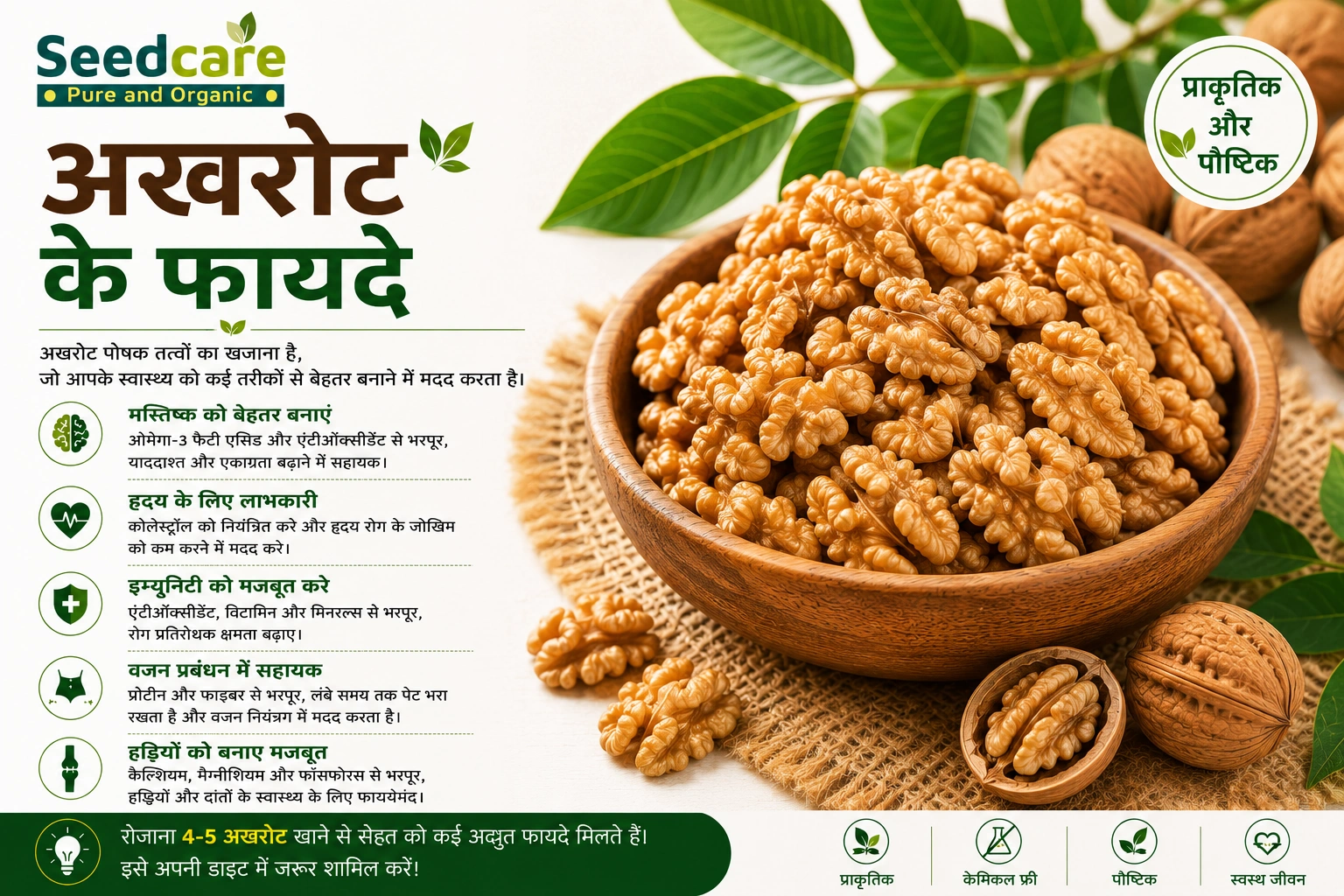
Walnuts for Brain Health: The Complete Clinical Evidence Guide for Indians
Walnuts are the only tree nut with 9.1g ALA omega-3 per 100g, ellagitannins (metabolised to brain-protective urolithins), and gamma-tocopherol — the neuroprotective Vitamin E form. Clinical evidence: 26% lower cognitive decline risk, 26% lower depression probability, Alzheimer's amyloid reduction. Complete guide covering MIND diet, children's brain development, soaking protocol, California vs Mamra, 5 brain recipes and 12 FAQ.
In this article: The shape that predicted the science | 3-compound brain protection | ALA omega-3 → DHA | Polyphenol story | Cognitive function RCTs | Depression evidence | Alzheimer's prevention | Memory improvement | Children's brain | MIND diet | Melatonin and sleep | How many, when, soaking | California vs Mamra for brain | 5 brain recipes | 12 FAQ
Walnuts for Brain Health: The Most Evidence-Rich Nut in Neuroscience
The observation that walnuts look like brains is ancient — both Eastern and Western medical traditions noted the resemblance and used it as a sign that walnuts were intended for brain health. The Doctrine of Signatures (16th century) formalised this into herbalist practice. Most such observations are coincidence or superstition.
This one turned out to be correct.
Walnuts are the only tree nut with a meaningful omega-3 content — 9.1g ALA per 100g, more than 20× the omega-3 of almonds and 65× that of cashews. They contain ellagitannins (polyphenols) that are metabolised by gut bacteria into urolithins — compounds that cross the blood-brain barrier and reduce neuroinflammation. They contain gamma-tocopherol, a specific form of Vitamin E that is neuroprotective in a way that alpha-tocopherol (the common form in almonds) is not. And they contain melatonin — the highest concentration in any tree nut.
What follows is the complete evidence review for walnuts and brain health — what the randomised controlled trials show, what the observational studies show, and what is still emerging.
Why Walnuts Are Uniquely Positioned for Brain Health
| Brain Health Factor | Walnuts | Almonds | Cashews | Pistachios |
|---|---|---|---|---|
| Omega-3 (ALA per 100g) | 9.1g ✅ | 0.0g | 0.1g | 0.3g |
| Polyphenols (ellagitannins) | High — unique to walnuts ✅ | Low | Very low | Moderate |
| Gamma-tocopherol (Vit E) | Most abundant ✅ | Low | Moderate | Low |
| Melatonin | 3.5mcg/g (highest tree nut) ✅ | Low | Minimal | Present (different) |
| Folate | 98mcg (25% DV) | 44mcg | 25mcg | 51mcg |
| Magnesium (nerve function) | 158mg (38% DV) | 270mg | 292mg | 121mg |
| GI | ~15 | 0 | 25 | <15 |
| Brain-specific research | Extensive — 20+ RCTs ✅ | Some | Limited | Growing |
The urolithin discovery
Ellagitannins (pedunculagin, tellimagrandin) in walnuts are metabolised by specific gut bacteria into urolithins A and B. Nutritional Neuroscience 2016: Urolithins cross the blood-brain barrier, reduce amyloid-beta aggregation (Alzheimer's plaques), and reduce neuroinflammation. This metabolic pathway — walnut → gut bacteria → urolithins → brain — is why gut microbiome health and walnut consumption are connected outcomes in brain health research.
The 3-Compound Brain Protection System
| Compound | Amount in Walnuts | Brain Mechanism | Specific Benefit |
|---|---|---|---|
| ALA Omega-3 | 9.1g per 100g | ALA → EPA → DHA (partially). Frontiers in Aging Neuroscience 2016: Omega-3 promotes neurogenesis (new neuron creation) in hippocampus — the memory centre. Reduces neuroinflammation. Supports myelin sheath integrity. | Memory, learning, mood regulation, reduced cognitive decline |
| Ellagitannins → Urolithins | Significant in walnuts (rare in other nuts) | Gut bacteria metabolise ellagitannins to urolithins A and B. These cross blood-brain barrier. Inhibit amyloid-beta aggregation. Activate AMPK (cellular energy pathway). Reduce NFκB inflammatory signalling. | Alzheimer's prevention, reduced brain inflammation, improved mitochondrial function in neurons |
| Gamma-tocopherol (Vit E) | 2.7mg per 100g (unique form) | Unlike alpha-tocopherol (common Vit E), gamma-tocopherol specifically neutralises reactive nitrogen species (RNS) — the key oxidative stress pathway in neurodegeneration. Alpha-tocopherol doesn't address RNS. | Neuroprotection against Parkinson's and Alzheimer's — specific to this Vit E form |
ALA Omega-3 and the Brain: How It Gets There
A common concern: ALA (alpha-linolenic acid — the plant omega-3 in walnuts) has to be converted to DHA to benefit the brain. The conversion rate is low (5–10% of ALA to DHA). Does walnut omega-3 actually reach the brain in meaningful amounts?
Frontiers in Aging Neuroscience 2016 systematic review: Yes — for three reasons:
- ALA itself has neurological activity independent of DHA conversion — reduces inflammatory cytokines that damage neurons directly
- Even low conversion is meaningful — 5% of 9.1g ALA (walnuts) = 0.46g DHA equivalent, comparable to significant fish intake
- Synergistic polyphenols enhance DHA retention — walnut polyphenols reduce the oxidative degradation of DHA in brain tissue, making existing brain DHA last longer
| Omega-3 Source | ALA per 100g | Est. DHA equivalent (5% conversion) | Brain Benefit Evidence |
|---|---|---|---|
| Walnuts | 9.1g ✅ | ~0.46g DHA equivalent | Extensive — 20+ RCTs |
| Flax Seeds | 22.8g | ~1.14g DHA equivalent | Good — primarily heart studies |
| Chia Seeds | 17.8g | ~0.89g DHA equivalent | Growing — fewer brain-specific RCTs |
| Salmon (comparison) | 0g ALA | 2.2g DHA (direct) | Extensive |
| Almonds (comparison) | 0.0g ALA | None | Limited brain-specific evidence |
| Cashews (comparison) | 0.1g ALA | Negligible | Very limited |
Cognitive Function: What the Randomised Controlled Trials Show
Most nutrition research uses observational studies — people who eat more walnuts tend to have better cognition. Causality is not proven. Randomised controlled trials (where people are randomly assigned to eat walnuts or not) are the gold standard. Here is what those trials show:
| Study | Design | Protocol | Key Finding |
|---|---|---|---|
| WAHA Trial — American Journal of Clinical Nutrition 2020 | RCT, 2 years, 708 older adults | 30–60g walnuts/day vs walnut-free diet | Significant improvement in episodic memory, working memory, and processing speed in the walnut group. Effect strongest in those with higher cardiovascular risk. |
| Journal of Nutrition, Health & Aging 2015 | Cross-sectional, 4,822 adults (NHANES data) | Walnut consumers vs non-consumers | Walnut consumers had 26% lower odds of poor cognitive function. Dose-response: more walnuts, better outcomes. |
| UCLA Longevity Center Study | Cross-sectional, 5,000+ adults | Dietary pattern analysis | Walnut consumption independently associated with better cognitive performance, improved memory, faster processing speed, more flexible thinking. |
| Nurses' Health Study (long-term follow-up) | Prospective cohort, 15,000+ women, 6 years | Long-term nut consumption tracking | Greater long-term nut consumption (especially walnuts) associated with better cognitive function at follow-up. |
What "26% lower odds of poor cognitive function" means in practice
From the NHANES study: adults who ate walnuts had 26% lower probability of scoring in the "poor cognitive function" category on standardised tests. This is a meaningful reduction — comparable to the benefit of several years' difference in biological age. For a 60-year-old Indian professional concerned about memory, this is clinically significant.
Depression and Anxiety: The Omega-3 Mood Connection
Nutrients 2019 — large observational study (26,000+ US adults):
- Walnut consumers had 26% lower probability of depression compared to non-nut consumers
- Walnut consumers had significantly lower self-reported depression scores
- Effect was not seen with other nuts — walnut-specific (suggesting omega-3 mechanism, not general nut effect)
- Greater walnut consumption correlated with better energy levels, reduced hopelessness, and better interest in activities
The mechanism is well-established in psychiatric literature:
- Omega-3 increases serotonin receptor sensitivity (same target as SSRIs)
- Omega-3 reduces neuroinflammation — depression is now understood partly as an inflammatory disorder
- Omega-3 supports phosphatidylserine production in neuron membranes — improves cell-to-cell signalling
- Folate (25% DV in walnuts) supports serotonin and dopamine synthesis
For Indians specifically
Depression and anxiety are significantly underdiagnosed in India — stigma, limited mental health resources, and cultural factors contribute. The nutritional approach (consistent omega-3 consumption through walnuts) does not replace professional care for clinical depression but is a meaningful, accessible, stigma-free component of mental health maintenance. 7–8 walnuts daily alongside regular outdoor activity and social connection is the nutritional foundation most psychiatrists would endorse.
Alzheimer's Prevention: The Amyloid-Beta Evidence
Alzheimer's disease involves the accumulation of amyloid-beta plaques in the brain. Nutritional Neuroscience 2016 — New York State Institute for Basic Research:
- Walnut extract reduced amyloid-beta aggregation in laboratory models significantly
- Animals fed walnuts showed less amyloid deposition, better spatial learning and memory
- Mechanism: urolithins (from ellagitannin metabolism) directly inhibit amyloid fibril formation
- Magnesium in walnuts additionally supports tau protein regulation (the other Alzheimer's marker)
Important context: these are animal and cellular studies — Alzheimer's prevention in humans requires 20+ year longitudinal studies that are underway but not complete. The mechanistic evidence is strong; the human clinical proof is still accumulating.
Prevention vs treatment
The evidence supports walnuts as a preventive strategy in cognitively healthy individuals — starting in midlife. There is no evidence that walnuts reverse established Alzheimer's disease. The window of maximum benefit appears to be prevention — ages 40–65, before significant amyloid accumulation has occurred.
Memory Improvement: The Hippocampal Connection
The hippocampus is the brain's primary memory formation centre. It is one of the few brain regions that continues to generate new neurons (neurogenesis) in adults — and this process is directly supported by omega-3.
Frontiers in Aging Neuroscience: ALA omega-3 increases BDNF (Brain-Derived Neurotrophic Factor) — often called "Miracle-Gro for the brain." BDNF promotes:
- Hippocampal neurogenesis — new neuron formation specifically in memory regions
- Long-term potentiation (LTP) — the cellular mechanism of memory formation and retention
- Dendritic spine density — more connections between neurons = more memory capacity
- Synaptic plasticity — ability to strengthen connections through learning and practice
Journal of Nutrition, Health & Aging 2015: In adults 20–59 years, walnut consumers showed significantly better scores on tests of memory, concentration, and information processing speed. The effect was seen across all age groups — not just elderly.
Children's Brain Development: The Critical Window
Nutrients 2017 — children's omega-3 and cognitive outcomes:
- DHA is essential for myelination — the insulation of nerve fibres that determines processing speed
- Children with higher omega-3 intake showed better reading ability, attention, and cognitive performance
- Critical periods: birth to age 2 (rapid brain development), and adolescence (prefrontal cortex development)
- Plant omega-3 (ALA from walnuts) partially converts to DHA — important for vegetarian/vegan children
| Age Group | Walnut Recommendation | Form | Brain Benefit |
|---|---|---|---|
| 2–5 years | 2–3 walnut halves (crushed) | Crushed or in food — choking hazard whole | Myelination, language development |
| 6–12 years (school age) | 4–6 halves daily | Whole, or in breakfast | Attention, memory, academic performance |
| 13–18 years (adolescence) | 7–8 halves daily | Whole — as snack | Prefrontal cortex development, emotional regulation |
| Adults 20–60 (prevention) | 7–8 halves (28g) | Any form | Cognitive maintenance, depression prevention |
| 60+ years (neuroprotection) | 7–14 halves daily | Soaked (easier digestion) | Alzheimer's prevention, cognitive decline reduction |
The Indian parent's advantage
The traditional Indian practice of giving children soaked walnuts and Mamra almonds in the morning has deep nutritional justification. The omega-3 in walnuts specifically supports the school-age and adolescent brain during its most critical development window. A child who eats 5–7 walnuts daily through school years may have meaningfully better attention and memory outcomes.
The MIND Diet: Walnuts Are the Only Nut Specifically Named
Alzheimer's and Dementia 2015 — Rush University Medical Center: The MIND diet (Mediterranean-DASH Intervention for Neurodegenerative Delay) reduces Alzheimer's risk by up to 53% in high adherence and 35% even in moderate adherence.
The MIND diet specifies nuts — and uniquely, walnuts are the only nut singled out by name in the scoring protocol. The reason: only walnuts provide the combination of ellagitannins + omega-3 that distinguishes them from other nuts in brain health outcomes.
| MIND Diet Category | Recommendation | Why |
|---|---|---|
| Nuts (general) | ≥5 servings per week | Protein, healthy fat, anti-inflammatory compounds |
| Walnuts (specifically) | Preferred nut — ideally daily | Omega-3 + ellagitannins + gamma-tocopherol combination |
| Green leafy vegetables | ≥6 servings/week | Folate, Vitamin K |
| Berries | ≥2 servings/week | Flavonoids |
| Olive oil | Primary cooking oil | MUFA + polyphenols |
| Fish | ≥1 serving/week | DHA + EPA (direct) |
| Whole grains | ≥3 servings/day | B vitamins, fibre |
Sleep and Melatonin: The Hidden Brain Benefit
Nutrition 2005: Walnuts contain 3.5mcg melatonin per gram — the highest of any tree nut. Eating walnuts significantly raises blood melatonin levels (measured in the study — this is verified, not theoretical).
The brain-sleep connection is direct: sleep is when the brain's glymphatic system (its cleaning mechanism) clears metabolic waste including amyloid-beta and tau proteins — the same proteins that accumulate in Alzheimer's. Poor sleep = reduced glymphatic clearance = accelerated amyloid accumulation.
- Walnuts before bed: melatonin improves sleep onset and quality
- Better sleep → better glymphatic clearance → reduced amyloid accumulation
- Tryptophan in walnuts → serotonin → melatonin synthesis pathway (additional)
- Magnesium (38% DV) → GABA activation → deeper sleep stages
Evening walnut protocol for sleep and brain
5–7 walnut halves 1–2 hours before bed. Melatonin content + tryptophan + magnesium work synergistically for sleep quality. Better sleep directly supports long-term brain health. This is a double benefit — brain nutrition and sleep quality from the same food.
How Many Walnuts, When, and How to Eat Them
| Goal | Daily Amount | Best Time | Best Form | Why |
|---|---|---|---|---|
| General brain maintenance | 7–8 halves (28g) | Morning with breakfast | Soaked or raw | Standard evidence-based serving |
| Depression/anxiety support | 7–14 halves (28–56g) | Morning + evening split | Raw or soaked | Higher omega-3 for mood — clinical doses |
| Alzheimer's prevention (40–65) | 7–14 halves | Consistent daily timing | Any form | Long-term prevention requires consistency |
| Children (6–12) | 4–6 halves | Morning school snack | Whole or crushed in oats | School hours = benefit during learning |
| Sleep improvement | 5–7 halves | 1–2 hours before bed | Raw or with warm milk | Melatonin timing — before sleep onset |
| Exam/productivity boost | 7–8 halves | 30 min before study | Soaked (faster digestion) | Short-term memory and focus improvement |
Soaked vs Raw vs Dry Roasted: Does It Matter?
| Form | Omega-3 Preserved | Polyphenols | Digestibility | Taste | Best For |
|---|---|---|---|---|---|
| Raw (fresh, unsoaked) | 100% | 100% | Good | Slightly bitter, complex | Adults comfortable with bitterness |
| Soaked overnight ✅ | ~95% | ~90% | Best ✅ | Milder, less bitter ✅ | Elderly, children, digestion concerns |
| Dry roasted (light) | ~80–85% | ~85% | Good | Nuttier, more intense | Snacking, cooking |
| Oil-fried/heavily roasted | ~50–60% ❌ | Significantly reduced ❌ | Variable | Rich but oxidised | Not recommended for brain benefit |
Soaking protocol
Soak 7–8 walnut halves in 100ml cold water overnight (8 hours). In the morning: drain, peel the skin (optional — it contains some tannins that may cause slight bitterness). Eat on empty stomach or with breakfast. Soaking also reduces phytate content by 20–25%, improving mineral absorption.
California Walnuts vs Mamra Almonds for Brain Health
A note on common confusion: both Mamra almonds and walnuts are called "brain foods" in India. They work through completely different mechanisms:
| Brain Mechanism | Walnuts | Mamra Almonds |
|---|---|---|
| Omega-3 (main brain fat) | 9.1g ALA per 100g ✅ | 0g — negligible |
| Polyphenols (ellagitannins) | Present — unique ✅ | Different polyphenols |
| Gamma-tocopherol | Highest in walnuts ✅ | Alpha-tocopherol (different) |
| MUFA (oleic acid) | Moderate (28%) | High (40%+) ✅ |
| Melatonin | 3.5mcg/g ✅ | Low |
| BDNF support | Via omega-3 ✅ | Via Vitamin E |
| Alzheimer's specific evidence | Extensive ✅ | Limited |
| Depression evidence | Strong ✅ | Moderate |
| Ayurvedic classification | Not classified | Medhya Rasayana ✅ |
The ideal combination
Eat both: 7–8 walnut halves for omega-3, ellagitannins and melatonin. 5–7 soaked Mamra almonds for MUFA, Vitamin E and Medhya Rasayana properties. Together they cover every major mechanism in brain nutrition. This is why traditional Indian practice included both in the morning ritual.
5 Brain-Health Walnut Recipes
1. Brain-Boost Morning Soak (The Daily Ritual)
| Ingredient | Amount |
|---|---|
| Walnut halves | 7–8 (28g) — soaked overnight |
| Mamra almonds | 5–7 — soaked overnight |
| Warm water | As needed to soak |
Soak both overnight in separate bowls. Morning: drain, peel skins, eat both together or separately. Nothing more. This 2-minute morning ritual provides omega-3, ellagitannins, gamma-tocopherol, MUFA and Medhya Rasayana properties simultaneously. The traditional Indian practice — validated by modern neuroscience.
2. MIND Diet Brain Smoothie
| Ingredient | Amount | Brain Nutrient |
|---|---|---|
| Walnut halves | 8 halves (28g) | Omega-3, ellagitannins |
| Ground flax seeds | 1 tbsp | Additional ALA omega-3 |
| Frozen blueberries | 100g | Flavonoids, anthocyanins |
| Baby spinach | 30g | Folate, Vitamin K |
| Almond milk or coconut milk | 250ml | Base |
| Banana (frozen) | ½ | Potassium + sweetness |
| Cinnamon | ½ tsp | Blood sugar stability |
Blend all. This smoothie contains omega-3 (walnut + flax), flavonoids (blueberries), folate and Vitamin K (spinach) — hitting four of the seven MIND diet food categories in one breakfast.
3. Walnut Halwa (Traditional Indian Brain Food)
| Ingredient | Amount |
|---|---|
| Walnut halves | 100g (coarsely crushed) |
| Ghee | 2 tbsp |
| Jaggery (grated) | 50g |
| Warm milk | 100ml |
| Cardamom | 1 tsp |
| Saffron | 5–6 strands |
Heat ghee in a heavy pan. Add walnuts, roast 3–4 minutes on medium. Add jaggery (dissolved in warm milk). Stir until thick. Add cardamom and saffron. Serve warm. Traditional Kashmiri recipe — akhrot halwa. The combination of walnut omega-3 with ghee (saturated fat carrier) actually improves fat-soluble vitamin absorption.
4. Brain-Food Roti (Daily Omega-3 Upgrade)
| Ingredient | Per 10 Rotis |
|---|---|
| Whole wheat atta | 2 cups (240g) |
| Walnuts (coarsely ground) | 4 tbsp (40g) |
| Ground flax seeds | 2 tbsp (20g) |
| Water + pinch salt | As needed |
Combine ground walnuts and flax with atta before adding water. Knead normally. Roll and cook. Each roti adds 3.6g ALA omega-3 — a meaningful daily dose without changing your meal structure. Children eat it without noticing. The walnut adds a mild nutty richness.
5. Sleep-and-Brain Evening Milk
| Ingredient | Amount | Benefit |
|---|---|---|
| Full-fat warm milk | 300ml | Tryptophan + calcium |
| Walnut halves (blended smooth) | 5 halves | Melatonin + omega-3 |
| Saffron | 3–4 strands | Anti-inflammatory crocin |
| Cardamom | Pinch | Digestive + fragrance |
| Honey | ½ tsp (optional) | Mild sweetness |
Blend walnuts with 50ml warm milk until smooth paste. Heat remaining milk, add walnut paste, saffron and cardamom. Stir well. Drink 30–60 minutes before bed. Melatonin (walnuts) + tryptophan (milk) + magnesium (walnuts) = complete sleep support. Better sleep = better glymphatic brain cleaning overnight.
Nutrition Per Serving
| Nutrient | Amount (28g — 7–8 halves) | % Daily Value | Brain Relevance |
|---|---|---|---|
| Calories | 185 kcal | — | Concentrated brain fuel |
| ALA Omega-3 | 2.57g | High ✅ | Neurogenesis, anti-inflammatory |
| Gamma-tocopherol | 0.7mg (unique form) | Neuroprotective ✅ | RNS neutralisation in neurons |
| Ellagitannins → Urolithins | Significant (unique) | Unique ✅ | Amyloid-beta clearance |
| Melatonin | ~0.9mcg | Meaningful | Sleep → glymphatic clearance |
| Magnesium | 44mg (11% DV) | 11% | Neural signalling, sleep quality |
| Folate | 27mcg (7% DV) | 7% | Serotonin + dopamine synthesis |
| Copper | 0.45mg (50% DV) | 50% | Dopamine + norepinephrine synthesis |
| Manganese | 1.0mg (43% DV) | 43% | Antioxidant enzyme SOD2 in brain |
| Glycaemic Index | ~15 | Very Low ✅ | Stable brain glucose supply |
Frequently Asked Questions
How many walnuts should I eat per day for brain health?
7–8 walnut halves (28g) is the standard serving used in most clinical trials, including the 2-year WAHA trial. This is the minimum effective dose for measurable cognitive benefit. Higher doses (14–20 halves, 56g) have been used in clinical depression studies. Start with 7–8 halves daily — consistent daily consumption over 3+ months produces the most meaningful outcomes.
Can walnuts improve memory?
Journal of Nutrition, Health & Aging 2015: Adults aged 20–59 who consumed walnuts regularly had significantly better scores on memory, concentration and processing speed tests. Mechanism: omega-3 increases BDNF (Brain-Derived Neurotrophic Factor) which promotes hippocampal neurogenesis — new neuron formation in the brain's memory centre.
Are walnuts good for depression?
Yes — with meaningful evidence. Nutrients 2019 (26,000+ adults): walnut consumers had 26% lower probability of depression. The effect was walnut-specific — not seen with other nuts, suggesting omega-3 as the key mechanism. Omega-3 increases serotonin receptor sensitivity (same target as SSRIs) and reduces neuroinflammation. Clinical depression requires professional treatment; walnuts are a useful nutritional adjunct.
Can walnuts prevent Alzheimer's?
Nutritional Neuroscience 2016: Walnut extract reduced amyloid-beta aggregation significantly in laboratory models. The mechanism (urolithins from ellagitannin metabolism crossing the blood-brain barrier) is established. Human prevention trials are ongoing. The current evidence supports walnuts as a meaningful prevention strategy in cognitively healthy adults — not a treatment for established Alzheimer's.
Is it better to eat walnuts soaked or raw?
Both provide the full brain benefit. Soaked overnight: phytates reduce 20–25% (better mineral absorption), bitterness reduces, digestion improves. Raw: 100% omega-3 and polyphenol retention. The difference is small — consistency matters more than form. Choose whichever makes you more likely to eat them daily. Soaking protocol: 7–8 halves in cold water overnight, drain in the morning.
What is the best time to eat walnuts?
For cognitive performance: morning (empty stomach or with breakfast). For sleep support: 1–2 hours before bed (melatonin + tryptophan + magnesium). For children during school: morning snack. For depression: consistent daily consumption matters more than timing — choose a time you will maintain as a habit.
Are walnuts good for children's brain development?
Nutrients 2017: Omega-3 is essential for myelination of nerve fibres and prefrontal cortex development. Children 6–12: 4–6 walnut halves daily. Adolescents: 7–8 halves daily. Under 5: crushed (choking hazard). Traditional Indian practice of soaked walnuts for school-age children has direct neuroscientific validation.
How do walnuts compare to fish for brain health?
Fish provides DHA directly — the primary brain omega-3. Walnuts provide ALA, which converts partially (5–10%) to DHA. Fish is more efficient per gram for DHA delivery. However, walnuts uniquely provide ellagitannins (metabolised to urolithins that prevent amyloid accumulation) and gamma-tocopherol — compounds fish doesn't contain. For vegetarians and vegans in India: walnuts + ground flax seeds is the best plant-based combination for brain omega-3.
Do roasted walnuts have the same brain benefit?
Light dry roasting preserves approximately 80–85% of ALA omega-3. Heavy roasting at high temperatures or oil roasting significantly degrades omega-3 (up to 40–50% loss). For maximum brain benefit: raw or soaked is best. Lightly dry roasted is acceptable. Avoid oil-fried or heavily roasted varieties.
What is the MIND diet and how do walnuts fit in?
The MIND diet (Mediterranean-DASH Intervention for Neurodegenerative Delay) reduces Alzheimer's risk up to 53% in high adherence (Alzheimer's & Dementia 2015). It specifies five nuts servings per week, with walnuts specifically named as the preferred nut — the only nut singled out by name in the scoring protocol — because only walnuts provide the omega-3 + ellagitannin combination that distinguishes them in brain health outcomes.
Can I eat walnuts if I have a nut allergy?
Walnut allergy exists and can be severe (anaphylaxis). If you have any tree nut allergy, test with a very small amount first under medical supervision. Walnut allergy and almond allergy do not always cross-react — they are different proteins. If you know you are allergic to walnuts specifically, do not consume them. Brain omega-3 can then come from flax seeds and chia seeds.
Where can I buy quality walnuts for brain health in India?
Seedcare California Walnut Kernels — premium California halves, FSSAI certified, no shell to deal with, fresh kernels. Available in 250g, 500g, 1kg packs at store.seedcare.in. Look for: pale, golden kernels (fresh) rather than dark brown or grey (rancid). Smell: mild and nutty, not sharp or paint-like.
The Brain Case for Walnuts, Summarised
| Goal | Evidence Level | Protocol |
|---|---|---|
| Cognitive function maintenance | Strong (multiple RCTs) ✅ | 7–8 halves daily, morning |
| Depression reduction | Strong observational + mechanistic ✅ | 7–14 halves daily, consistent |
| Alzheimer's prevention | Moderate (animal + mechanistic — human RCTs ongoing) | Daily consumption starting midlife |
| Memory improvement | Moderate-Strong ✅ | 7–8 halves daily, 3+ months |
| Children's brain development | Strong (omega-3 mechanism) ✅ | 4–8 halves daily by age |
| Sleep quality | Moderate (melatonin measured in studies) | 5–7 halves 1–2 hrs before bed |
More from Seedcare
Related Articles