 Comparison Guides
⭐ Featured
Comparison Guides
⭐ Featured
Medjool vs Kimia Dates: Complete Comparison Guide for India — Which Should You Buy?
Complete comparison of Medjool vs Kimia dates for India — nutrition side-by-side, physical differences (size, texture, taste), price comparison, and clear verdict for every use case. Medjool: soft, large, caramel-sweet, premium gifting. Kimia: firm, dark, higher polyphenols, economical daily use.
In this article: What each date is | Complete nutrition side-by-side | Physical differences (size, texture, taste) | Price comparison | Which is healthier | Dates vs refined sugar (the GI reality) | Benefits both share | Where Medjool wins | Where Kimia wins | Pregnancy (the clinical trial) | Ramadan / Iftar | Pre-workout use | Indian cooking uses | How to choose | Storage guide | 10 FAQ
Medjool Dates vs Kimia Dates: The Complete Comparison Guide for India
Two dates. Both delicious. Both nutritious. Completely different characters. The question "which is better — Medjool or Kimia?" is asked every month by thousands of Indians buying dates online, and the answer is almost always: it depends on what you are buying them for.
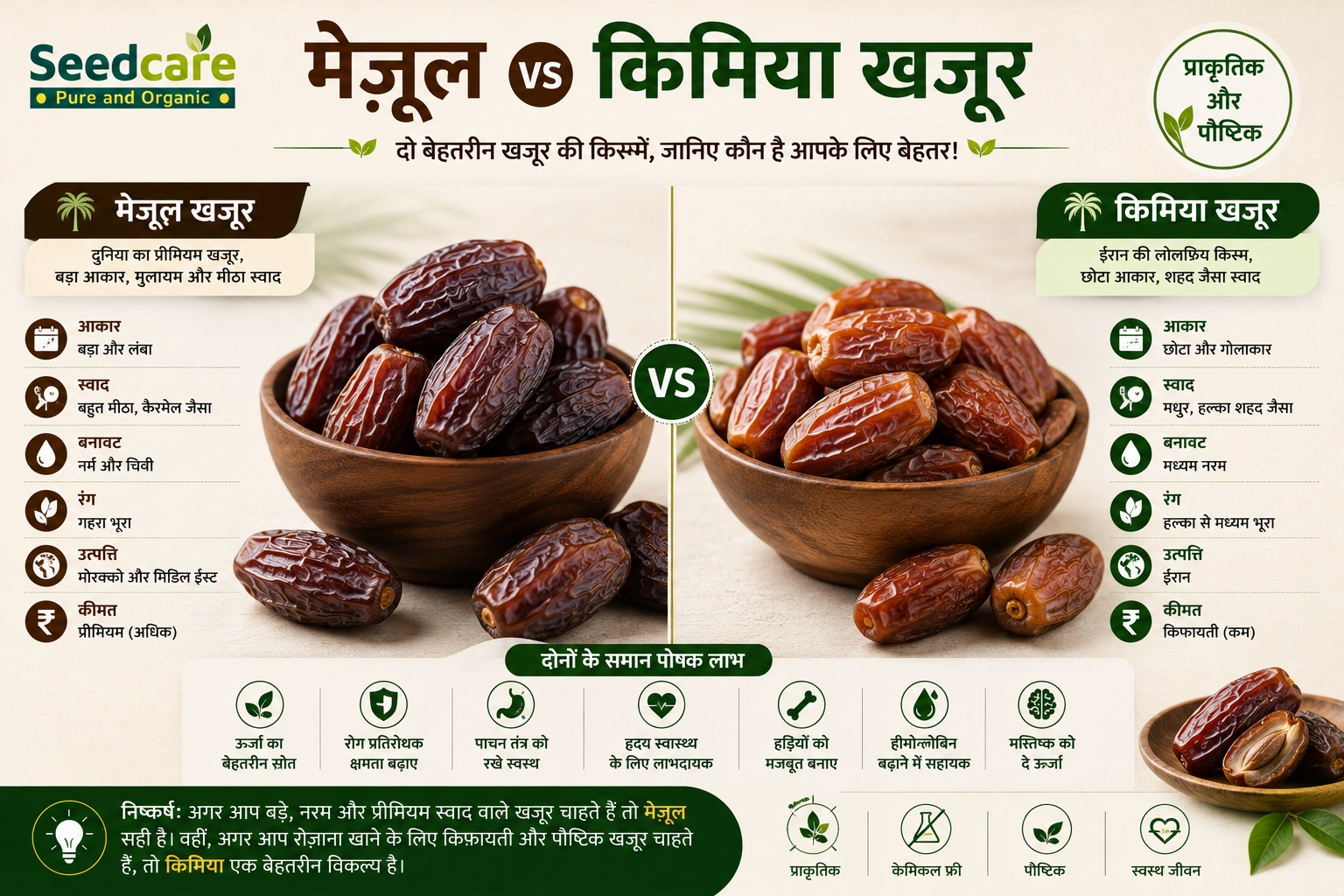
Medjool dates are the "king of dates" — large, soft, caramel-sweet, expensive, and the premium gifting choice. Kimia dates are Iranian black dates — smaller, drier, more intensely flavoured, higher in polyphenols, and significantly more affordable for daily consumption. Each has genuine advantages that the other doesn't.
This guide covers the complete nutritional comparison, specific use-case recommendations, the clinical evidence on dates and pregnancy, and a clear verdict for every purchasing situation.
Complete dates benefits guide (Hindi): खजूर खाने के फायदे | Ramadan dates guide: Best Dates for Ramadan Iftar and Suhoor.
What Are Medjool Dates?
Medjool dates (Phoenix dactylifera 'Medjool') originated in Morocco and are now primarily grown in Israel, Jordan, USA (California) and Morocco. They are the largest commercially available date variety — typically 25-30g per fruit, compared to 8-12g for most other varieties. The Medjool's exceptionally high moisture content (21%) gives it the characteristic soft, almost pudding-like texture and intensely sweet caramel-toffee flavour.
In India, Medjool dates are a premium import — priced significantly above other varieties. They have become the standard choice for quality gifting, festive hampers, and health-conscious consumers who want the most luxurious eating experience from a natural food.
What Are Kimia Dates?
Kimia dates (also spelled "Kimiya") are an Iranian variety of Phoenix dactylifera — one of the most consumed date varieties in Iran. They are medium-sized (12-16g per fruit), dark brown to black in colour, with a firmer and slightly drier texture than Medjool. The black skin concentrates tannins and polyphenols, giving Kimia a more intense, slightly less sweet, and more complex flavour profile.
In India, Kimia dates are the most popular everyday premium date — significantly more affordable than Medjool while offering comparable core nutrition. They are the standard choice for daily consumption, Ramadan iftar, and anyone who wants nutritional benefits without the Medjool price premium.
Physical and Visual Comparison
| Property | Medjool Dates | Kimia Dates |
|---|---|---|
| Origin | Morocco, Jordan, Israel, California (USA) | Iran (primary: Bam region, Kerman province) |
| Size | Large — 25-35g per fruit ✅ | Medium — 12-18g per fruit |
| Colour | Amber to dark brown | Dark brown to black ✅ (higher polyphenols in black skin) |
| Texture | Very soft, moist, almost pudding-like ✅ | Firm, slightly chewy, less moist |
| Moisture | ~21% ✅ | ~13-15% |
| Taste | Intensely sweet, caramel, toffee notes ✅ | Rich, less sweet, more complex, slightly tannic |
| Stone (seed) | Large, easily removed | Smaller, easily removed |
| Shelf life | 12-18 months sealed | 18-24 months sealed ✅ (lower moisture = longer life) |
| Price in India | Premium — ₹900-1,400/kg typical | Standard premium — ₹600-900/kg typical |
| Best for eating | Direct eating, gifting, desserts ✅ | Daily use, Ramadan, cooking, snacking ✅ |
Complete Nutrition Comparison
Source: USDA FoodData Central | Per 100g:
| Nutrient | Medjool Dates | Kimia Dates (approx.) | Notes |
|---|---|---|---|
| Calories | 277 kcal | ~279 kcal | Nearly identical — Kimia slightly denser (lower moisture) |
| Total Carbohydrate | 74.9g | ~74-76g | Similar — both primarily glucose + fructose + sucrose |
| Sugars | 66.5g | ~68-70g | Both high natural sugar — portion control important |
| Fibre | 6.7g (27% DV) | ~6.5-7g | Fibre is why dates have lower GI than their sugar content suggests |
| Protein | 1.8g | ~2.0g | Low — dates are not a protein food |
| Potassium | 696mg (20% DV) | ~650-700mg | Highest mineral in both — blood pressure, heart rhythm |
| Magnesium | 54mg (13% DV) | ~52mg | Sleep, BP, insulin sensitivity |
| Copper | 0.36mg (40% DV) | ~0.35mg | Collagen, dopamine, melanin |
| Manganese | 0.3mg (13% DV) | ~0.3mg | SOD2 antioxidant enzyme, bone |
| Iron | 0.9mg (5% DV) | ~0.9mg | Low — not a significant iron source |
| Vitamin B6 | 0.25mg (15% DV) | ~0.24mg | Mood, PMS, serotonin/dopamine |
| Folate | 15mcg (4% DV) | ~15mcg | Cell division, pregnancy |
| Vitamin K | 2.7mcg (2% DV) | ~2.5mcg | Low |
| Polyphenols/Tannins | Moderate | Higher ✅ (black skin) | Kimia's darker skin concentrates more tannins and polyphenols |
| GI | ~42-46 ✅ | ~35-40 ✅ | Both low-medium GI — lower than expected given sugar content |
Why dates have lower GI than their sugar suggests
Journal of Food Science 2011: despite containing 66-70g sugar per 100g, both Medjool and Kimia dates have GI approximately 35-46 — lower than white bread (GI 75) and much lower than white sugar (GI 65). The mechanism: 6.7g fibre per 100g slows intestinal glucose absorption significantly. Additionally, the fructose component (approximately 31g/100g in Medjool) has inherently lower GI than glucose or sucrose. Dates are a genuinely reasonable natural sweetener for most purposes — not a "healthy sugar" but meaningfully better than refined alternatives.
Where Medjool Dates Win
| Use Case | Why Medjool is Better | Recommendation |
|---|---|---|
| Gift giving ✅ | Larger, more luxurious appearance — visually impressive in gift boxes. The "premium date" that recipients recognise | Medjool dates in 500g or 1kg gift boxes — the standard premium Indian gifting choice |
| Direct eating experience ✅ | Soft, pudding-like texture with caramel sweetness — unmatched eating pleasure among date varieties | Eat 2-3 Medjool dates as a dessert or sweet treat replacement |
| Natural sweetener in recipes ✅ | Softer texture blends more easily into smoothies, date paste, date balls — no pre-soaking needed | Blend for date paste (1:1 dates:water) for baking and energy balls |
| Stuffed dates (mithai) ✅ | Large size accommodates fillings — almonds, pistachios, cashew cream | Remove stone, stuff with nut of choice — premium homemade gift |
| Children's sweet substitute ✅ | Sweetest variety — children who resist dates often accept Medjool; soft enough for young children | 1 Medjool date replaces 1 tsp sugar in most contexts |
Where Kimia Dates Win
| Use Case | Why Kimia is Better | Recommendation |
|---|---|---|
| Daily consumption ✅ | Significantly more affordable — ₹200-400/kg less than Medjool. For 3-5 dates daily, cost adds up significantly over a month | Kimia dates for the daily 3-5 date habit — same core nutrition at 30-40% lower cost |
| Ramadan Iftar ✅ | Higher polyphenol content from black skin — the traditional iftar date. Iranian Kimia is the standard Ramadan date globally | 3-5 Kimia dates with water at Magrib to break fast — traditional Prophetic sunnah |
| Higher polyphenols ✅ | Black skin concentrates tannins, proanthocyanidins and anthocyanin-related compounds not present in Medjool's amber skin | For antioxidant benefit: Kimia — darker colour = more polyphenols |
| Lower moisture = longer shelf life ✅ | 13-15% moisture vs 21% — stays fresh longer, especially in India's warm humid climate | Buy in bulk (1-2kg) — Kimia stores well for 12+ months sealed |
| Pre-workout energy ✅ | Firmer texture = easier to eat quickly. 3 Kimia dates = 84 kcal of fast-releasing energy at lower cost than Medjool | 3-5 Kimia dates 30-45 min before exercise |
| Cooking and mithai ✅ | More affordable in large quantities needed for cooking. Darker colour adds visual depth to date-based sweets | Khajoor barfi, date chutney, stuffed rotis — Kimia in bulk is economical |
Benefits Both Dates Share
1. Pregnancy — The Clinical Trial Evidence
Journal of Obstetrics and Gynaecology 2011 — RCT: 69 pregnant women who consumed 6 dates daily in the 4 weeks before their due date had significantly better labour outcomes than the control group:
- Cervical dilation on admission: 3.52cm (date group) vs 2.02cm (control) — significantly more advanced labour
- Intact membranes on admission: 83% (date group) vs 60% (control)
- Oxytocin use: needed in only 28% of date group vs 47% of control group
- Latent phase of labour: 510 minutes (dates) vs 906 minutes (control) — significantly shorter
Proposed mechanism: dates contain tannin compounds that may stimulate uterine smooth muscle contractions and oxytocin receptors. Both Medjool and Kimia contain these compounds — Kimia slightly more due to higher tannin concentration in the dark skin.
Practical pregnancy protocol
6 dates daily in the last 4 weeks of pregnancy (weeks 36-40). Both Medjool and Kimia are appropriate — Kimia is more economical for this 4-week daily protocol. Dates also provide potassium (reduces leg cramps), magnesium (prevents premature contractions), and natural energy for the final trimester. Discuss with your OB/GYN before starting.
2. Natural Energy and Pre-Workout
- Glucose + fructose combination: glucose provides immediate energy; fructose replenishes liver glycogen for sustained energy — the ideal sports nutrition sugar combination
- No processing required: the body absorbs date sugars efficiently without the metabolic cost of processing refined sugar
- Potassium (20% DV): prevents muscle cramps during exercise
- Magnesium (13% DV): ATP energy production and muscle contraction
- 3-5 dates 30-45 minutes before exercise = 84-140 kcal of accessible energy — the most traditional pre-workout food in the Middle East for exactly this reason
Full Ramadan performance guide: Best Dates for Ramadan Iftar and Suhoor — India Guide.
3. Gut Health
Food and Nutrition Research 2014: dates show significant prebiotic activity — the soluble fibre (6.7g/100g) selectively feeds Bifidobacterium and Lactobacillus. Additionally:
- Insoluble fibre adds bulk, speeds intestinal transit time — natural constipation relief
- Tannins (more in Kimia) have mild antimicrobial properties against pathogenic gut bacteria
- Pectin content: maintains mucous membrane of intestinal lining
4. Heart Health
Journal of Agricultural and Food Chemistry 2009: dates significantly reduced LDL and total cholesterol and increased HDL in a controlled trial.
- Potassium (20% DV): the primary blood pressure mineral — counters sodium's pressor effect
- Fibre: reduces LDL through bile acid binding
- Polyphenols and tannins: prevent LDL oxidation — the atherogenic form of cholesterol
- Magnesium: relaxes arterial smooth muscle
5. Brain, Mood and Sleep
- Tryptophan (present in dates): precursor to serotonin and melatonin
- Vitamin B6 (15% DV): cofactor for serotonin and dopamine synthesis
- Magnesium (13% DV): GABA receptor activation — reduces anxiety, improves sleep onset
- Potassium: supports nerve signal transmission and nervous system function
6. Dates vs Refined Sugar — The Key Comparison
| Property | Dates (Medjool/Kimia) | White Sugar | Jaggery (Gur) |
|---|---|---|---|
| GI | ~35-46 ✅ | 65 | ~65-84 |
| Fibre | 6.7g/100g ✅ | 0g | <0.5g |
| Potassium | 696mg (20% DV) ✅ | 0mg | ~1050mg |
| Magnesium | 54mg (13% DV) | 0mg | ~29mg |
| Polyphenols | Present ✅ | None | Some |
| Processing | Whole food — none | Heavily refined | Minimally refined |
| Calories per tsp equiv. | ~23 kcal (1/3 date) | 16 kcal | 17 kcal |
| Verdict | Best natural sweetener ✅ | Worst | Better than sugar, worse than dates |
How Many Dates Per Day? — Dosage Guide
| Purpose | Daily Amount | Which Variety | When |
|---|---|---|---|
| General health / daily habit | 3-5 dates | Kimia (economical) | Morning or afternoon |
| Pre-workout energy | 3-5 dates | Kimia or Medjool | 30-45 min before exercise |
| Ramadan Iftar (break fast) | 3 dates + water | Kimia — traditional | Immediately at Magrib time |
| Suhoor (pre-fast meal) | 2-3 dates | Kimia | End of suhoor — sustained energy |
| Pregnancy (final month) | 6 dates daily | Either — Kimia for cost | Throughout the day |
| Natural sweetener (cooking) | 2-4 dates paste | Either — {lnk(L_MEDJ,"Medjool")} blends easier | In recipe |
| Gifting | 500g-1kg | Medjool ✅ | Year-round, festivals, Eid |
| Diabetics | 1-2 dates max | Either — monitor glucose | With meals — see diabetics guide |
| Children | 1-2 dates | Medjool (sweeter, softer) | As sweet/dessert replacement |
For diabetics — use dates carefully
Despite lower GI than refined sugar, both Medjool and Kimia dates are high-sugar foods (66-70g sugar per 100g). The clinical evidence shows healthy individuals can eat dates without significant blood sugar impact, but diabetics on insulin or sulfonylureas should limit to 1-2 dates per sitting and monitor individual glucose response. See: Dry Fruits for Diabetics India — Complete Guide.
Indian Uses for Medjool and Kimia Dates
1. Khajoor Milkshake (Date Shake)
3 pitted Medjool dates + 250ml cold milk + pinch cardamom + saffron strand. Blend smooth. Medjool dates blend creamier than Kimia — the natural caramel flavour makes this taste like a premium milkshake without added sugar. Pre-workout or post-workout recovery drink. One glass: ~350 kcal, natural sugars, potassium, magnesium.
2. Date Paste (Replaces Sugar in All Baking)
10 pitted Medjool dates (or 15 Kimia) + 6 tbsp water. Blend to smooth paste. Store refrigerated 2 weeks. Use 1:1 to replace sugar in cakes, ladoos, energy balls. GI ~42 vs sugar's 65. Fibre 6.7g/100g vs sugar's 0g. The most practical whole-food sugar replacement in Indian baking.
3. Khajoor Aur Badam Ke Ladoo (Energy Balls)
| Ingredient | Amount |
|---|---|
| Pitted dates (Medjool or Kimia) | 200g |
| Almonds (dry roasted, roughly chopped) | 100g |
| Desiccated coconut | 50g |
| Cardamom | 1 tsp |
| Ghee (if needed for binding) | 1 tsp |
Blend dates to paste. Mix all ingredients by hand. Roll into 20-25 balls. Refrigerate 30 minutes to set. No added sugar, no cooking. Each ball: ~90 kcal, natural date sugars, almond protein and Vitamin E, coconut MCT. Perfect Diwali mithai substitute, children's snack, or pre-workout energy ball. Stays fresh refrigerated 2 weeks.
4. Dates Chutney (With Tamarind — Imli Khajoor Chutney)
8-10 pitted Kimia dates + 2 tbsp tamarind + 1 tsp cumin + black salt + water. Blend smooth, adjust consistency. Kimia's more complex flavour and higher tannins work better than Medjool in savoury chutney. The standard chaat chutney — every Indian street food stall uses a version of this. Home-made with Kimia dates is far more nutritious than bottled imli sauce.
5. Iftar Plate
3 Kimia dates + glass of water. Break fast with this. The Prophetic sunnah — medically validated by the clinical trial showing glucose-fructose combination restores blood sugar gently after 14+ hours of fasting without the spike of processed sweets. Kimia is the traditional iftar date variety across the Gulf, Iran and South Asia.
Storage Guide
| Storage | Medjool | Kimia |
|---|---|---|
| Room temp (sealed) | 2-3 months | 4-6 months (lower moisture) |
| Refrigerated | 6-12 months ✅ | 12-18 months |
| Freezer | 3 years | 3 years |
| Signs of spoilage | Mould, sour smell, hardening (normal if dried out — not spoiled) | Mould, off smell (firmness is normal) |
| Humidity risk | Higher ✅ (21% moisture — mould risk in humid India) | Lower (drier — more stable) |
| Best storage for India | Refrigerate once opened | Sealed container at room temp or refrigerated |
The Verdict: Which Should You Buy?
| Situation | Choose | Why |
|---|---|---|
| Daily eating (3-5 dates/day habit) | Kimia ✅ | Cost-effective, excellent nutrition, longer shelf life |
| Gifting (Diwali, Eid, birthdays) | Medjool ✅ | Premium appearance, luxurious eating experience |
| Ramadan Iftar and Suhoor | Kimia ✅ | Traditional variety, economical for 30-day daily use |
| Pregnancy (final trimester) | Kimia ✅ | For 6-date daily protocol: more economical; higher polyphenols |
| Children's sweet substitute | Medjool ✅ | Sweeter, softer — better accepted by children |
| Pre-workout energy | Kimia ✅ | Firmer, easier to eat quickly; more economical in bulk |
| Cooking and recipes | Kimia ✅ | Affordable in large quantities; complex flavour for savoury |
| Best polyphenol/antioxidant content | Kimia ✅ | Darker skin = more tannins and polyphenols |
| Blending (smoothies, date paste) | Medjool ✅ | Higher moisture = softer = blends without pre-soaking |
| First time trying dates | Medjool ✅ | Most approachable eating experience — best first impression |
Frequently Asked Questions
Which is healthier — Medjool or Kimia dates?
Nutritionally they are very close — both Medjool and Kimia dates provide similar calories (277-279 kcal/100g), sugar (~66-70g), fibre (6.7g), and minerals (potassium 20% DV, magnesium 13% DV). Kimia dates have a slight advantage in polyphenols due to their darker skin concentrating more tannins — but the difference is not dramatic. For practical purposes, both are equally nutritious whole foods.
Why are Medjool dates so much more expensive?
Medjool dates are more expensive because: (1) they are larger (25-35g per fruit vs 12-18g for Kimia — you get fewer per kg); (2) they have higher moisture (21% vs 13-15% — they weigh more per fruit but contain more water); (3) they are considered a premium variety with higher market positioning; (4) most quality Medjool is imported from Israel, Jordan or USA. For daily nutrition, Kimia dates deliver the same health benefit at 30-40% lower cost.
Can I eat dates every day?
Yes — 3-5 dates daily is a reasonable habit for most healthy adults. Both Medjool and Kimia dates are whole foods with fibre, potassium and polyphenols. The GI (~35-46) is lower than refined sugar. For diabetics: limit to 1-2 dates and monitor glucose response. For weight management: account for the caloric density (~30 kcal per Kimia date, ~75 kcal per Medjool).
Are dates good for pregnancy?
Yes — specifically in the last 4 weeks. RCT 2011: 6 dates daily in weeks 36-40 significantly improved labour outcomes (shorter latent phase, less oxytocin needed, better cervical dilation). Both Medjool and Kimia are appropriate — Kimia is more economical for this extended daily protocol. Always confirm with your OB/GYN.
Are Medjool dates the same as regular dates?
No — Medjool is a specific premium variety (cultivar) of Phoenix dactylifera, notable for its large size, soft texture and sweet caramel flavour. "Regular dates" in India typically refers to varieties like Kimia (Iranian), Safawi, Ajwa or Zahedi — all the same species but different cultivars with different size, texture and flavour profiles.
Which date is best for Ramadan?
Kimia dates are the standard Ramadan iftar date across the Gulf, Iran and South Asia — traditional, correct flavour profile, economical for 30-day daily use. 3 dates with water at Magrib to break fast is the traditional sunnah. For full Ramadan nutrition protocol: Best Dates for Ramadan Iftar and Suhoor. Medjool is also appropriate for iftar — the traditional practice is any good date.
Can diabetics eat Medjool or Kimia dates?
Both Medjool and Kimia have lower GI than refined sugar (~42 and ~38 respectively). Clinical evidence shows healthy individuals can eat 3-7 dates without significant blood sugar impact. For diabetics: limit to 1-2 dates per sitting, always with a meal rather than alone, and monitor individual glucose response. Kimia's slightly lower GI makes it marginally better for diabetics. Full guide: Dry Fruits for Diabetics India.
How to store dates in India?
Medjool dates should be refrigerated after opening due to their high moisture content (21%) — India's humidity can cause mould. Kimia dates are more stable at room temperature in a sealed container due to lower moisture. Both keep 12+ months refrigerated. Buy in larger quantities — both varieties store well and buying in bulk (500g-1kg) is more economical than 100g packets.
Which date is better for energy?
Both are excellent pre-workout energy sources. Kimia dates are slightly better for pre-workout because their firmer texture is easier to eat quickly and they are more economical in the quantities needed for daily training. 3-5 Kimia dates 30-45 minutes before exercise = 90-150 kcal of glucose + fructose energy. The potassium (20% DV) helps prevent muscle cramps.
Where to buy Medjool and Kimia dates online in India?
Seedcare Medjool Dates and Seedcare Kimia Dates — premium grade, FSSAI certified, pit-in (stone present — natural, longer shelf life than pitted). Pan-India delivery. 250g to 1kg. Check for: no added sugar, no preservatives, no artificial coating. Seedcare sources directly from Iran (Kimia) and premium growing regions (Medjool).
Two Dates for Two Purposes
Keep both. Kimia in a jar on the kitchen counter for the daily 3-5 date habit, pre-workout, cooking and Ramadan. Medjool in the fridge for gifting, special occasions, children's sweet substitute, and the days when you want the best eating experience a date can offer.
Seedcare Medjool Dates → | Seedcare Kimia Dates → | All dry fruits →
More from Seedcare
Related Articles